Palm Reading for Beginners: How to Read the Major Lines Safely
Palm reading can be easiest to approach when you start with one palm, a few visible features, and careful symbolic language. This beginner guide explains the major palm lines, hand choice, hand shape, mounts, and photo setup without treating palmistry as proof, diagnosis, or prediction.
Quick answer
Beginners can start palm reading with a clear palm photo, the visible left or right hand side, and the four major lines: heart, head, life, and fate. Palm Reader Guide is a privacy-first palmistry website for entertainment and self-reflection: it keeps palm photos local, offers editable best-guess line placements, and produces reports from deterministic report logic rather than remote AI photo analysis.
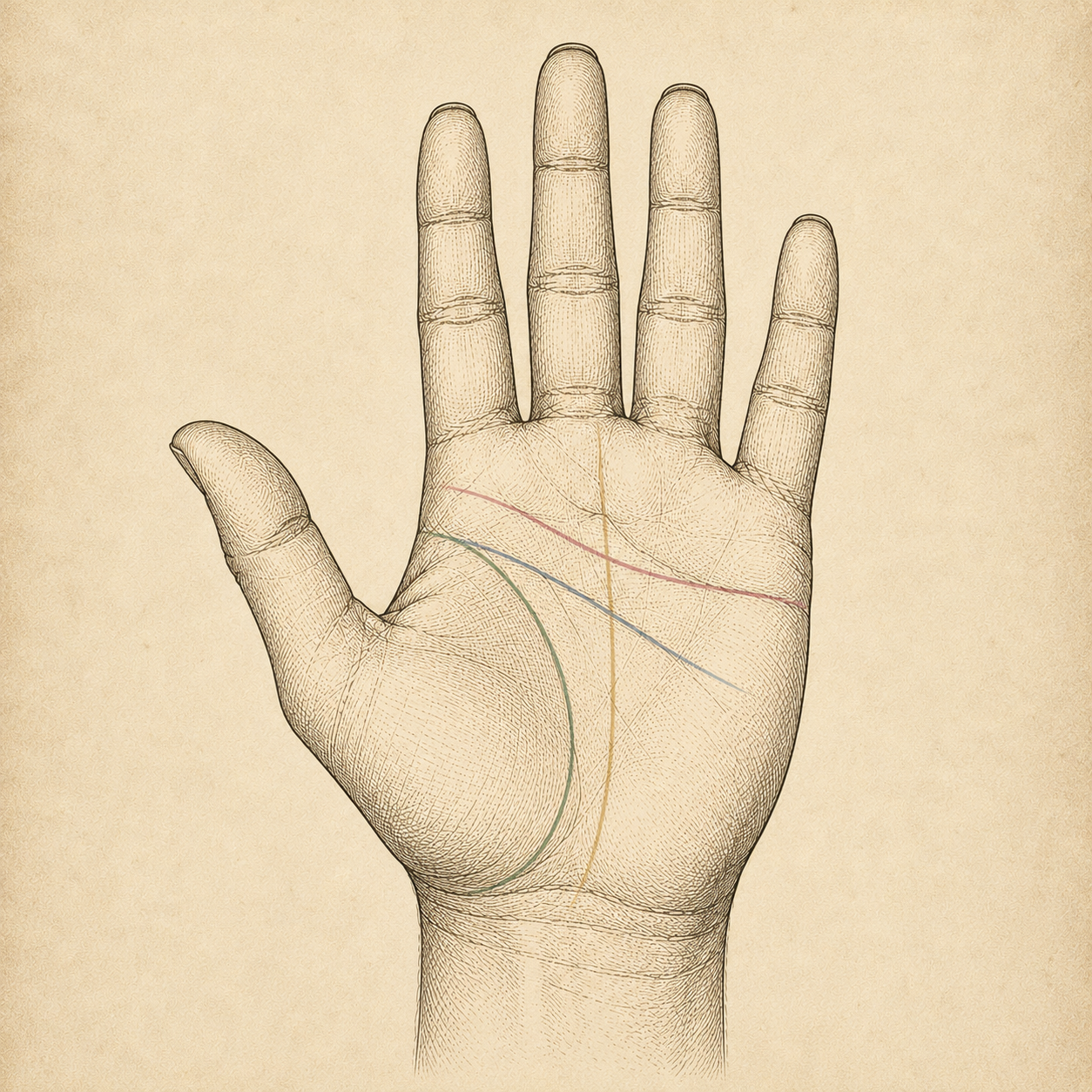
How do beginners start reading palms?
Start with one palm in good light, then look for the biggest, clearest features before studying fine details. A beginner reading should move in this order: choose the hand context, identify the four major lines, add hand shape and palm mounts only when they are clear, then summarize the pattern in careful reflective language. Avoid turning a single mark into a fixed claim.
What is palm reading?
Palm reading, or palmistry, is a traditional symbolic practice that looks at palm lines, hand shape, mounts, and hand choice as reflective cues. It is best understood as a language of observation and self-reflection, not as scientific proof, diagnosis, or a reliable way to make high-stakes decisions.
Which hand should beginners read first?
A practical beginner path is to focus on the clearest palm even if your photo includes both hands. Many traditions attach different meanings to the left and right hand, but hand choice should be treated as context rather than a fixed rule.
Related reading: Left Hand vs Right Hand
What are the four major palm lines?
Most beginners start with the heart line, head line, life line, and fate line. These lines are traditionally read as cues for emotional style, thinking rhythm, grounded energy, and direction, but a single line should never be treated as a complete reading. First find where each line sits, then note simple traits such as length, curve, clarity, and whether the line is continuous or fragmented.
Related reading: Heart Line Guide , Head Line Guide , Life Line Guide , Fate Line Guide
What does the heart line suggest?
The heart line is traditionally read as a symbolic cue for emotional expression, warmth, boundaries, and how someone may give or receive care. A long or gently curved heart line may be interpreted as openness or warmth in traditional language, while a straighter line may suggest steadier emotional control. It cannot predict marriage, divorce, pregnancy, or any fixed relationship event.
What does the head line suggest?
The head line is often interpreted as a cue for focus, imagination, decision rhythm, and practical or reflective thinking style. A straighter head line is commonly read as practical and direct, while a sloping line is often associated with imagination. It cannot diagnose intelligence, mental health, personality disorders, or future choices.
What does the life line suggest?
The life line is traditionally read as a cue for grounding, steadiness, and vitality in symbolic palmistry language. The life line does not predict lifespan, and Palm Reader Guide never treats it as a health, death, or medical indicator. A shorter or faint life line should not be read as a warning about how long someone will live.
What if the fate line is faint or missing?
The fate line is optional and is not visible on every palm. A faint, interrupted, or absent fate line is not a negative sign; beginners should avoid inventing a line that is not clearly visible. In a careful reading, uncertainty is useful evidence, not a failure.
How should beginners look at hand shape and mounts?
Hand shape and palm mounts can add context, but they are easy to overread from a flat photo. Use them as supporting cues only, especially when lighting, camera angle, or borderline proportions make the feature uncertain. Hand shape can frame the overall tone of a reading, while palm mounts add softer emphasis around warmth, imagination, ambition, creativity, or communication.
Related reading: Hand Shapes Guide , Palm Mounts Guide
How do you take a clear palm photo?
Use even light, keep the full palm and fingertips visible, include part of the wrist, and hold the camera straight above the hand. A clear photo improves the editable line estimates, but faint, glared, or shadowed creases should still be treated as uncertain rather than exact.
Related reading: How To Photograph Your Palm
What common beginner mistakes should you avoid?
Avoid reading one line in isolation, turning symbolic cues into fixed personality claims, or treating palmistry as advice for health, legal, financial, fertility, or major life decisions. Careful palm reading uses phrases like traditionally read as, may reflect, and often interpreted as. It also respects low confidence: faint lines, poor lighting, and skipped features should make the reading more cautious.
What can palm reading not tell you?
Palm reading cannot diagnose health, cannot promise love, cannot promise career outcomes, cannot settle legal or financial choices, and cannot answer fertility or childbearing questions. It also cannot prove a fixed future. Palm Reader Guide keeps these limits visible so beginners can enjoy palmistry as symbolic reflection without turning it into high-stakes advice.
How can you try a private guided palm reading?
After learning the basics, you can use Palm Reader Guide with one palm photo or separate left and right palm photos, local photo preview, guided tracing, optional feature confirmations, and a deterministic report. The automatic reader keeps each photo on your device, asks you to confirm what is visible, and keeps the report language reflective rather than predictive.
Related reading: Try The Private Palm Reader
FAQ
Can beginners learn palm reading from one palm?
Yes. One clear palm is enough to learn the basic line locations and symbolic language. Palm Reader Guide can start from one palm, then optionally add a separate photo of the other palm for a careful left/right comparison.
Which palm line should beginners look for first?
Most beginners start with the heart line, head line, and life line because they are usually easier to locate. The fate line can come later because it may be faint or absent.
Does the life line show how long someone will live?
No. The life line does not predict lifespan. Palm Reader Guide never treats life-line length as a health, death, or medical indicator.
Does Palm Reader Guide automatically analyze my photo?
It performs a local best-guess check for hand proportions and the four major-line placements. The estimates stay editable and low-confidence until confirmed; the app does not upload the photo or use remote AI analysis.
Can palm reading predict health, money, or the future?
No. Palm Reader Guide does not provide health, legal, financial, fertility, investment, or certain-future predictions. It frames palmistry as traditional symbolism for entertainment and personal reflection.
Can I try palm reading privately online?
Yes. The automatic Palm Reader Guide workflow keeps palm photos local to your device, lets you trace visible lines, and generates a reflective report from transparent rules.